I just spent the morning reviewing a new report by Marianne Sorensen from Tandem Social Research Consulting titled "Rural British Columbia Profile: A Fifteen-year Census Analysis (1991-2006). The report is well worth a read to become more familiar with the trends on overall quality of life and disparities in rural areas. (report obtained on the link above - see bottom of the page under publications).
The report provides insights on the current status and historical trends in rural BC. Throughout the report, I was reminded of the complexity of the situation in rural areas of the province due to the range of factors that are influencing change and due to the fact that not all rural areas are the same. I have made this point numerous times in the past because I find that many times rural areas are spoken of as one entity - when in reality, and as the report highlights well - there are oftentimes greater differences between rural areas than between rural and urban areas.
I wanted to highlight this resource today and will reference the report throughout other blogs - but today I wanted to link the report to the provision of higher education throughout BC. If capacity building is one of the central assumptions in the revitalization of rural areas - we need to ask hard questions about the role of higher education institutions in this province.
Rural development and access to higher education
The findings in the report show that rural BC residents are less likely to attain a University degree and possible explanations include that youth may have less aspirations to attend Universities and that there are less Universities located in rural areas. Perhaps because I spend a lot of time in the academic world, I see this issue as a priority. Our Universities and Colleges, for the most part are situated in or close to our urban centers which decreases access for rural youth. In my experience, access is not just limited by increased costs associated to relocation but includes more social and psychological issues as well. Many of my rural students have expressed that they were intimidated by urban centers or universities, that they felt social pressure when they chose to leave their community and for others - that they felt marginalized when they returned to a rural area with their education.
This area, as suggested in the study, is ripe for more research. If getting young people to relocate and settle in rural areas is central to rural development we need to understand more about those already located within rural areas and also youth in urban centers. For example - what are the aspirations of rural youth and how does education fit into those aspirations? What inhibitors, if any, exist and what could be done to limit or remove them to further enable rural youth to participate in higher education? What are the perceptions of urban youth about rural areas? What factors are they most influenced by with respect to their choice of location upon graduation? Do rural areas have these? How can rural areas use their amenities to attract youth to relocate? These are questions I see on the "demand" side of the equation for re population of rural areas.The only communities that survive in the future will be those where people vote with their feet - and these people need to reflect all ends of the age spectrum.
The report hints at questions around the supply side of higher education in rural areas of BC as well. Many questions come to mind to understand if our current system is limiting choice and opportunity for rural youth. Higher education is directly linked to economic indicators such as income attainment. It is one form of capacity building that could provide long term solutions to the obvious leakage of population from our rural areas. I question whether or not higher education institutions view the issue of rural education provision as one of their mandates. If higher education was seen as a more central component in the rural development puzzle, should we not see more collective and systematic efforts to address these disparities? For some reason, we always get hung up on the bricks and mortar approach to education provision - or the location of facilities in rural areas. This is one of the issues, yes - but I think we need to perhaps think beyond this traditional approach to education services and incorporate more outreach type models into our system. Learning is indeed place-based - place matters not only in terms of where we learn, but in what we learn about. We need to ask ourselves are there ways we could provide higher education IN rural areas in ways that meet the needs of rural learners? Are there models working elsewhere that we can pilot? Are there other agencies that could be partners in this endeavor that share the goal of rural development? These questions need to also recognize that the idea of "on-line learning", while useful for many - is not the solution for meeting the needs of rural residents at this time due to infrastructure issues with the Internet. More innovative ideas need to come to the forefront to address this issue.
I am not naive about the higher costs associated to providing education in rural areas - our public institutions are no longer "public" but are driven on a semi-private model where "bums in seats" or enrollment management is critical to their survival. Likely, the ability of our current higher education institutions to respond to the issue of rural development will require stronger connections between provincial government ministries that share the goal of rural revitalization. Expanded networks and cross cutting approaches to develop a strategy that addresses the rural/urban disparities may be needed.
A final note on this topic - when my position was created (to work with rural communities in BC to incorporate amenity based industries in their diversification efforts), capacity building was built into my work plan. To date, I have attempted to bring young people out into rural areas using outreach methods, I have worked with colleagues to bring education and resource sessions to rural operators (conferences, manuals, workshops) and I have worked with colleagues to try and embed "rural" as a concept in our urban university classrooms. I plan to expand these types of strategies and invite ideas and partners from elsewhere to expand opportunities for rural residents to learn about sustainable amenity development in ways that work for them. And, I will continue to find ways to filter knowledge about the rural realities in BC into decision making circles to agitate for innovative ways to move forward.
Friday, September 17, 2010

Monday, August 23, 2010
Increasing domestic travel - kudos to new marketing campaigns

I have often called for stronger marketing campaigns to increase domestic tourism for a number of reasons:
1. Rural areas often rely on rubber tire markets for tourism as they have limited other travel infrastructure. They are often in need of marketing efforts that encourage urbanites to travel closer to home to experience what is in their own backyard.
2. The ecological footprint associated to travel is linked to distance from origin (with higher impacts coming from air travel) - therefore traveling in one's back yard can be seen as a green"er" travel choice.
3. Many Canadians (or British Columbians to be more local) are unaware of the rich natural and cultural amenities within our own region. Tourism marketing has often branded very stereotypical images of Canada and its subregions which can dilute the breadth and diversity of experiences that are available.
Year after year however, I see that the dominant view in tourism tends to be to attract international travelers (especially high yield markets) to inject "new" money into the economy. While this is important, this ideology has perhaps skewed the systems and programs in the tourism industry at the expense of those who rely on more domestic travel markets. I have long heard from operators in rural areas "I don't care if my visitor is from Vancouver or Frankfurt - if they stay, pay and play - I am able to stay in business". And of course, if they stay in business - the overall travel experience is better for all, the local community is able to benefit and so on...
I have been quite pleased this summer to see the ramped up efforts in BC and at the Canadian level with marketing campaigns aimed at getting people to travel within their own vicinity. The innovative "Locals Know" campaign by the Canadian Tourism Commission has caught my attention numerous times. They have been engaging Canadians to contribute images, stories and their own experiences and the photos on their site help to showcase unique places and people across the country. More recently as well, BC has ramped up their efforts to get people traveling by car into more remote and unique areas of the province by showcasing driving routes. As someone who has traveled most highways in BC, I am pleased to see that these driving routes give people good reason to explore their own backyard, linking experiences and enticing them off the beaten track.
Hopefully these efforts work to motivate travel within our borders, engaging our residents to be more knowledgeable about what is here and then share that with others. Just about every survey that asks how people find out about places indicates the power of "word of mouth". This powerful tool can only be used when people have experienced something first hand. I hope that this effort at domestic marketing pays off for rural operators and that is produces a whole new generation of ambassadors for travel within Canada.
Wednesday, August 18, 2010
Back in (or out) of the saddle

Hello all,
I should have explained the absence from this blog for the past couple of months prior, but I was away on summer vacation. One of the advantages of my position is being able to take time off in the summer to enjoy the great amenities in the province. For me, this time was largely spent in the saddle, literally, as I am an avid equestrian. So back at work and into a new saddle.
Time in the saddle this summer brought me to many different destinations in the province and I couldn't help but think more about the potential role of equestrian tourism in BC. More and more people are travelling with their pets, and some of these are traveling with their horses. We've seen all sorts of modifications of tourism venues and services to provide for traveling pets, but I must admit - these are lagging behind for horses.
Traveling with horses can be a stress inducing experience as it usually involves trucks and horse trailers and live, precious cargo. It is important to have places to pull over and stop regularly to allow horses legs to rest or to provide water. Some like to take horses out of the trailer as well to allow them to stretch out their legs, especially on long hauls. Waiting in long ferry line ups or the hot sun is a real concern as trailers can soon become like an oven. And of course, deciding where to stay overnight with horses can be a challenge as few places allow this currently.
At the same time, there are a number of equestrians in this province who travel regularly with their horses either for competition or to access trails. Based on my conversations with many and my own experience, there is the potential to expand this travel by improving basic infrastructure, services and awareness among the equestrian community.
This summer I came upon a couple of notable venues that are worth mentioning. Last week I stayed at the Hills Health Ranch in 108 Mile House with my horses. They have worked with the Backcountry Horsemen of BC to construct and provide campsites for horses. The sites have small corrals, large parking areas for rigs, water, manure pits and maps to access some of the nicest trails I have ridden on in BC. They have housed this close to the main Ranch facilities so a $20 camping fee allows access to the showers, pool, restaurants and other amenities at the resort. We had a competitive trail ride on Saturday with about 30 riders from around the province attending (sport tourism) and all of us indicated we would be back. Check it out and if you are a resort, consider building on their concept as it was extremely popular.
The other venue closer to home that I visit regularly is Twincreeks Bed Bale and Breakfast in Duncan. A friend, Deborah Flinn provides overnight facilities for visitors, access to the trails and customized natural horsemanship lessons for visitors. She even puts on wine rides where you ride from winery to winery on horseback! Other friends, Doug and Mary Carr at Takala Ranch in Ladysmith have built a great little cabin and corrals for visitors to stay, ride and take part in Ranch activities.
When I speak of equestrian tourism to others, I often see a bit of confusion about what it is or the potential in BC. I honestly believe that we have the potential to position ourselves as an equestrian tourism destination based on our landscape and access to nearby markets with high horse ownership levels. Equestrian tourism is more than having visitors take a short trail ride on someone else's horse at a Ranch vacation. It needs to expand in scope to include a range of services and supports for those who travel regularly with their horses. We need more research to understand the size and scope of the market and to learn more about their travel needs in order to do this. And, we can learn from others that are leading the way (see horse travel in the USA for an example of how coordinated their services for horse travel are).
I sit on the joint trails access committee with Horse Council BC and am Vice President of the BC Competitive Trail Riders Association... Along with others, I hope we can further the conversations to allow folks to understand the full scope of potential with equestrian tourism and to harness it in the near future.
Wednesday, May 5, 2010
Connecting with others who "get rural"

Today I participated in a conference call for the Annual General Meeting of the Canadian Rural Research Network (CRRN). The CRRN is "is a new means to support information sharing and networking among stakeholders with an interest in rural research". The blog connects partners from across Canada working on topics related to the well being of rural communities - and I'd encourage people to check out their site and subscribe for their updates.
Sometimes as an academic who works on rural development topics, I find myself isolated and unable to fully tap into others who "get it". What I mean by that is that in order to study and contribute to rural development, one really needs to understand the complexities and realities of life in the rural context. I find that most academic institutions, programs and faculties use an urbancentric (or urban biased) approach to education and research. Our textbooks contain content with urban examples, urban processes and urban assumptions. Our campuses are located in urban settings which require rural youth to travel to obtain their education and strip rural areas of much needed human capital (for those campuses that are located in rural areas, they often have to rationalize their existence for public investment). I also note, that faculty are by and large not using "place based" teaching to help students understand rural areas.
These practices are not fully preparing students for engagement with rural areas. I remember years ago, I had a student that called after graduation and said "Nicole - this community doesn't have a Chamber of Commerce, a Planner, an Economic Development officer or a tourism marketing organization - so non of the stuff I learned about tourism development really fits here!". This was a good wake up call for me about the information that goes in - directly impacts their ability to create change when students are out in the field. Now, I use a rural lens when teaching, I encourage those from rural areas to comment on how approaches would work in a rural area, and most importantly - I take University students out into rural areas for "rural immersion" experiences for 3-4 weeks every year so they can develop a rural lens.
When I started to study rural tourism development in BC about a decade ago, I found that the word rural rarely appeared on the radar of academic institutions or within government agencies. For those that did recognize the word (and indeed this still needs clarity now and again) they often assumed that rural means agriculture or farming. While most of agriculture is rural, rural is much more than agriculture!
But things look up - there is a growing cluster of expertise in the academic world that has chosen to study a variety of topics in the rural context. The CRRN is one example that holds promise to connect researchers. The TRIP project that I lead in BC certainly connected a number of us in this region. I noticed a promising organized approach in Alberta called the Alberta Rural Development Network (having a conference next week!). And, next week I am attending a two day dialogue on rural policy in Victoria hosted by the BC Rural Secretariat. All of these initiatives are positive and demonstrate growing recognition of systems and stakeholders that are aligning to create more positive change for the people in rural Canada.
Wednesday, April 21, 2010
Preserving and promoting heritage assets for rural tourism

Yesterday I was contacted by someone from the National Trust for Historic Preservation in Washington, DC to bring to my attention a special issue of the Forum Journal (Winter 2010) that focused on Heritage-Based Rural Development.
BC has an active Heritage Branch in the Ministry of Tourism, Culture and the Arts and I have had the good fortune to work with many of their staff in the past. Efforts to bring together those in heritage preservation and tourism have been made in recent years as there is a growing recognition of the synergies that can happen when working together. Sometimes when blending people from different worlds – it is a good idea to focus first on common goals. I would like to propose in this blog, that those working on heritage tourism think a bit broader about how heritage can support rural development in general – not just through tourism. By following the suggestions and examples in the articles discussed above, the protection and promotion of heritage assets leads to the goals of many rural areas. For example heritage assets make communities more attractive to visitors, residents and businesses which can keep people in the community. It also invests in foundations of authenticity which can create places where people experience a “sense of place” (which is becoming difficult as all our cities begin to look alike).
So how do the journal articles suggest this happens – well I don't want to take away from your enjoyment in reading the articles – but here are a few highlights I gleaned. Based on two pilot projects (regional based) along the Mississippi River in Arkansas and in central Kentucky – James Lindberg’s article provides six principles for heritage based development including:
1. Use a regional approach
2. Protect historic authenticity
3. Nurture grassroots involvement and leadership
4. Forge strong partnerships
5. Be flexible, and
6. Make a long term commitment
Using these as guiding principles – they also propose six strategies for moving forward. I thought these were particularly useful for rural development:
1. Educate about the value of rural heritage
2. Conserve heritage assets
3. Encourage local entrepreneurship and the use of historic structures
4. Develop heritage tourism potential
5. Brand and market your regional identity
6. Advocate for public policies that support heritage-based rural development
2. Conserve heritage assets
3. Encourage local entrepreneurship and the use of historic structures
4. Develop heritage tourism potential
5. Brand and market your regional identity
6. Advocate for public policies that support heritage-based rural development
So without spoiling your read, go and review the articles (they are short) as they point out many tips under each strategy. I couldn’t help but think about the many examples of heritage resources in BC that I have visited over the years that are in dire need of conservation before they can be of any use for tourism. Many rural residents are aware of these assets and value the sites, places and people that have established roots to the area. The state of many sites however is unfortunate – old buildings crumbling or being demolished for new developments. Once they are gone, and once the people that are connected to these places are gone – these heritage resources will be much more difficult, if not impossible to revitalize.
Canadians often say that Canada doesn’t have its own culture (which I adamantly disagree with). Perhaps it is time we learn from others – even within our own country (i.e. Quebec efforts around heritage preservation are excellent) about what our heritage amenities are and then prioritize them as key ingredients for rural development. We know they are there, and we should know by now the roadblocks that are preventing them from being restored and utilized – so now all we need are creative ideas on how to get there (which starts with being a priority). With so much emphasis on “tourism product development” going on, heritage resources must be incorporated into these discussions in ways that balance the mandates of protection and promotion.
I like to expose myself to the thinking and practices south of the 49th whenever I can. There is a collective understanding about rural tourism development in the USA that Canada can, and should, learn from. Universities have supported extension activity in tourism across the States for quite some time and clusters of active regions have demonstrated many promising practices. Luckily, I will get the opportunity for more interaction with folks by attending the Rural Tourism Conference in Mississippi October 25-27th. For others who want to attend a good conference on rural tourism, keep your eyes open for the next National Extension Tourism Conference as well.
Monday, April 19, 2010
Staycations benefit rural areas and the environment

Folks have probably heard about a new type of getaway called the "staycation". A staycation is a vacation one takes close to home, to enjoy the adventures in their own backyard.
Why are staycations growing in popularity? There are many reasons for this trend including:
1. We have a "been there, done that" generation that has travelled far more than any other generation before it. It is no longer unique to travel to Europe, Southeast Asia or Africa because so many others have done this. In tourism we call this phenomenon "mass follows class" which means that while a few intrepid tourists find unique places, they soon share their experiences leading to the flow of mass travellers after them. Tourism is an activity with incredible "social bragging rights", and these rights go up when others are less likely to have gone where you have travelled. So how does this lead to a staycation? Staycations are somewhat less common than they used to be and people are now more prone to explore what is in their own backyard.
2. Concerns about the carbon footprint of travel are also making people rethink international travel. While all travel produces carbon, air travel is becoming more scrutinized for its contribution to global warming. And beyond air travel, people are looking to invest in travel experiences that benefit places and people.
3. The experience of travel to and from destinations is becoming a hassle for many. Increased security measures, confusion about regulations, required passports, screening practices and add on taxes are common complaints of air travelers. These hassles are felt more so by people who have to travel for their work and leads many to want to avoid travel when they have leisure time.
4. The pace of society in both work and leisure time has created a need for people to "slow down". Many have tried to create space to be more slow by packing less into their schedule - including travel experiences.
As people look to stay closer to home for their vacations, rural areas that are developing tourism stand to benefit. In order to benefit however, rural areas need to become more visible to urbanites. This is not an easy task as many Canadians are becoming increasingly disconnected to the rural landscape and the amenities, communities and people within. At your next social gathering when someone asks you where you are going on your summer vacation - suggest some rural areas in your province and see if they know where you are talking about. I have done this often when I tell folks that I'd like to get to the Chilcotin this summer... I can see their blank stares that indicate they have no clue where I am talking about.
For those working in rural tourism - you may want to ask yourself if your area could be attractive to urbanites who want to staycation this year. What do you have that could help them slow down, stay close to home and explore, reduce their carbon footprint and experience reality in their own life? Chances are, there are many things that would suit staycationers. Now how can you raise awareness that your rural area is worth exploring? Work with other small communities in your region and think about targeting some promotions to nearby urban markets. Assemble some packages that leave room for lots of exploration and flexibility while making it easy for them to decide. And start a buzz about staycations within the industry to encourage organizations to work together to market BC to British Columbians, spur the rubber tire market and revitalize rural tourism efforts. The spin offs? Rural areas will see increased visitation, added exposure may lead some people to relocate to rural areas as residents or to start a new business and BC residents will become better ambassadors for the province because they will know about its amenities (and will pass it on to other visitors).
And for you - plan a staycation to a part of rural BC this year to experience something unique.
Friday, April 9, 2010
Historical week for BC tourism

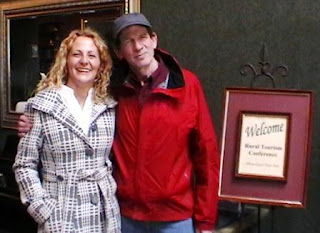


This week was an historic one for rural BC and for the role of tourism in its diversification. The first BC rural conference was held at the South Thompson Inn just outside of Kamloops as part of the REDTREE project by Thompson Rivers University. I have been to many conferences over the years and am joining others in saying that this is one of the best ever held in BC. Why was it so great?
The opportunities for learning were unlike any program I have seen assembled around tourism in BC - there were sessions on everything from sustainability, mountain bike trails, signage, product development and capacity building to Web tools, amenity migration and geocaching.
The delivery was innovative - there were lots of workshops, activities, plenaries and plenty of time for networking.
The venue was spectacular - the South Thompson Inn setting provided an intimate gathering spot and everyone remained on site to create space for networking and developing ideas. The staff was great and the food was fantastic (and local).
The delegate list was diverse - the session had lots of rural operators, council members, aboriginal leaders, policy makers from federal and provincial agencies, field agents, academics, consultants, students and marketing associations. This provided a rich set of players to share ideas, realities and voices to the complex array of stakeholders involved in tourism development. And, no one audience was privileged in their links to tourism in the province. They came from all corners of BC and from outside the province including Alberta, Quebec, California, Sweden and Brazil!
For me, the event was very special as it marked the realization of a vision that I shared with my colleagues in TRIP since 2006 when we learned that rural operators and leaders wanted a venue to get together to share and learn together. Watching people from all over the province shake hands, sit down together and learn from the wealth of knowledge around the venue was fantastic. I had the opportunity to reconnect with people we met on the road with our students, and I had the chance to meet new people like Anna Pollock and Joanne Steele whose work I have admired.
One of the goals of TRIP was to develop a cluster of expertise and network around rural tourism in BC and it was so evident that we can collectively check that one off our list. Our partners were well represented in the event, and some of my closest colleagues and students who engaged in TRIP extension tours were all around and involved. This showed the follow through and commitment of the partnership to seeing our ideas through and in fact, we are all leaving inspired to do more... (keep posted for new ideas for a TRIP phase 2!).
Congratulations to Rob Hood and his great team at TRU including Sydney Johnsen, Cynthia Schaap and all the great students. The organization was super and kept people engaged throughout. We truly had a great "experience". In particular though, when I talked about doing things using a rural lens, the team did many things to make the conference work for rural BC residents including:
They invited them to the event
They tailored the topics to suit their needs
They created a travel subsidy to make it accessible
They recognized that their time away from the community was valuable and ensured an action packed learning program
They kept it in a rural setting
They benefited a rural operator
They used workshops to allow for engagement and learning
They kept the speakers relevant to rural issues and realities
They focused on the big picture facing rural BC
They made room for socializing amongst delegates by having adventures, socials, bus outings, and plenty of networking time
And probably many more.
We are talking about the logistics for the next gathering and are committed to continue the opportunity. Keep posted, tell your contacts and register early because based on the success of this inaugural event - it will sell out super quick!
PS - the adventure studies program offered a social opportunity on Wednesday night and my team was called the "Roper's" due to Miriam Schilling's abilities with a lariat in one of the activities. Our team photo includes Gavin McLelland (being caught), Miriam Schilling, myself, Victoria Simpson,Kimberly May, and Sara Weaver (Simone Carlysle-Smith was missing for a moment).


Subscribe to:
Posts (Atom)