Well, many of you have been asking when the 2012 BC Rural Tourism Conference is happening so I thought we better update folks. There will be no 2012 conference but plans are underway for a spring conference in Smithers, BC for 2013. So stay tuned - as we are just starting that planning and will likely put out a call for folks to submit sessions early in the fall.
There are many opportunities for people to participate in other BC conferences that, while not the rural tourism conference, offer lots of education and networking opportunities for folks.
The National Aboriginal Tourism Conference is taking place March 28-20 in Osoyoos, BC
The BC Tourism Industry Association Conference is in Vancouver November 4-6th, 2012
The 8th Global Mural Tourism Conference: Economic Development Through Arts and Tourism is happening in Chemainus Sept 10-13, 2012
And there are numerous regional professional development opportunities taking place as well - so - stay tuned for the 2013 Rural Tourism Conference but in the mean time, take part in the events above or let me know of others that you have taking place!
Showing posts with label BC rural tourism conference. Show all posts
Showing posts with label BC rural tourism conference. Show all posts
Thursday, February 16, 2012

Thursday, April 21, 2011
Stories from the Trail - more from the Rural Tourism Conference


Guest Blog by Fran Thorburn
STORIES FROM THE TRAIL
MARTIN LITTLE JOHN – OPPORTUNITIES MOUNTAIN BIKE TOURISM
British Columbia is the epicentre of the mountain biking world and participation rates are still going up. There is a wide range of ages that are involved in this sport, with the median age at 30 years and the majority of participants being male. More and more women though are taking an interest in the sport.
Positive aspects to Mountain bike tourism are:
· That it is important to the industry.
· It is organized and led by the community.
· It supports the tourism growth and local recreation.
· It is a low investment.
· It encourages pride within the community.
3 critical factors to implementing the sport are;
1. Signage and maps of the trails and having a management system in place.
2. Having a local stakeholder alliance such as DMO’s, land manager and services.
3. Funding sources such as membership fees to cover the maintenance, infrastructure and marketing.
Two case studies were presented and the common threads were:
· It is important to have community support.
· Need to have a plan and make sure that all paper work is in place before starting construction of the trails.
· Build healthy relationships with all stakeholders and the community.
· Be aware of the competing interest such as forestry/logging.
· Make sure that land access, i.e. license of occupation and right of way agreements for using private properties are in order.
NOELLE KEKULA & CONNIE FALK – HORSE TRAILS AND CAMPSITE PARTNERSHIPS ON THE BONAPARTE PLATEAU – Again it was mentioned the importance on building healthy relationships and partnerships. An interesting piece of information was to go to the job creation program when in need of help as this is an area where you can get skilled people to help build trails and campsites. Advice given on where to start:
1. Talk to Recreation Sites and Trails on your plan and to see if it can work.
2. You need to find out where trail authorization is required.
3. Be prepared to spend time on the paper work and legalities as this is a slow drawn-out process.
4. Consultation takes place with all the stakeholders.
5. To avoid delay, have your plan as in-depth and complete as possible.
6. Work with First Nations, they love to share their culture, you need to understand what is important to them, i;e. they preserve culturally modified trees and to know which is a modified tree you will see a strip of bark removed while it was young.
7. Get to know the local ranchers as they will be a great help in the creation of the trails.
8. Have good collaboration with all stakeholders, as this is key.
BOOTSTRAP TOURISM
BILL RICHARDSON-STARTING A TOURISM INDUSTRY FROM SCRATCH
It was mentioned that the number one thing people are looking for is a relaxing atmosphere with friends and family. A strategy when you don’t have the resources is to take a small group and give them a wonderful experience. A tip given was that you could make something out of nothing for example a young entrepreneur decided to create a trail up a very steep hill in order to ride his mountain bike up there as fast as he could, which in turn has become a popular yearly competition bringing many visitors to the community.
Tourism development methodology
1. Identify tourism assets and options
2. Choose one tourism asset to develop
3. SWOT your tourism activity
4. Develop your strategy to overcome your challenges
5. Define your market
6. Develop a marketing strategy
7. Resource development (people, money, skills, infrastructure etc)
8. Build community support
9. Choose 5-8 key people to help build community support
There are two kinds of tourism, destination or diversion (when people are going to a destination they divert to another place). “A tourism product does not have to be big to be of high value”.
New trends in tourism are short get a ways within 150 miles or a once in a life time experience.
MOBILE WORKSHOPPAT CORBETT – WALKING THE HILLS HEALTH RANCH.
The theme of this workshop was to see some of the trails found on the ranch. There was a fair amount of conference visitors who took part in this activity. From the introduction that Pat gave us on some of the history of the ranch to the finish of the tour was a 2 hour exercise. The tour started off by walking through the corral campground which was an area that had a corral for each campsite. This allowed visitors that come to the ranch with their horses to have a safe place to keep their horsed during the night and while they were not out riding. The campsites are large to allow easy movability for large vehicles. The area is close to the lodge so that the visitors can easily walk up to the restaurant, showers, pool etc. The trail that runs through this campsite is the original gold rush trail which was a pretty amazing piece of information. It left me feeling a little in awe to know that this track had seen so much activity in the past and was still being used. From the campsite and still on the original gold rush trail we walked down trail 10 which led us to the main road where Pat showed us an underpass he had constructed to allow his visitors and community members a safe crossing to either side of the road. From here we turned left and came to the biathlon trail and shooting stadium. With all the dirt that was extracted for the making of the underpass, Pat had the shooting stadium built. This is a fairly large area with the dirt built up to create a wall in the shape of a half moon and this prevented the pellet bullets from going beyond the wall. Lots of starlings were out pecking for their breakfast while we were there. The walk then went on down the biathlon trail until we came to a fence marking the boundary. From there we basically just walked back, but on trail 21. All these trails are ski and skidoo trails in the winter. The biathlon has its own trails in a separate area. In the summer these trails become in use for mountain biking, walking, hiking and horse back riding. ATV’s are not allowed on the trails due to the damage they can cause. There were no signs as such up to guide visitors on what trails they were using except for the occasional sign stating it was a skidoo trail on a B for biathlon. Apparently signs go up when the season is about to start, so we were in between seasons and were therefore in the transition period. There are three categories of endurance trails to choose from, easy, moderate and advanced. The longest trail is 6.6 kms and is classed as an easy trail. The longest advanced trail is 3.5 kms. Maintaining these trails has a large cost to it. They have small machinery as well as a large snow plough when there is a lot of snow. With the amount of trails to be groomed and maintained it takes a lot of man hours. These trails are groomed and cleaned up twice a year. There is a $10.00 fee to use the trails, apart from people just walking the trails, so therefore it is always a worry that they get enough visitors using the trails in order to cover this cost.
CONCLUSION
This has been a full on, very informative and well organized conference. A lot of information has been shared in the last two days. What I saw as a common issue throughout the event is the challenge in either developing healthy relationships with stakeholders and politicians or being unaware of the importance of building these healthy relationships. I also learnt that small tourism businesses are not taken seriously by government and this has created huge challenges for these small tourism operators. It seems to me that education is a missing link here on a number of fronts. There needs to be awareness on the value of these businesses and how they are a sustainable means of economic growth. One area that needs to be addressed is the conflict between small businesses and land tenure and the power forestry have with the right to come onto that land and clear cut it. This seems a very unfair practise and an unbalanced process. If a lease is granted on crown land then government should honour that and not allow forestry the privilege of coming in and clear cutting that area. Could TIA not be involved in bringing rural tourism operators together as one voice to pressure government to change this policy? Again could TIA not bring awareness to the people of BC through a visual manner that this is goes on and that it not only affects sustainable businesses, but that clear cutting is still taking place in a big way in BC. I believe there needs to be more awareness on what sustainability looks like. We basically look at sustainability as an environmental issue, whereas it is much larger than that. Without a sustainable environment, we do not have a sustainable economy, a sustainable business environment or a sustainable life style; they all go hand in hand. Government needs to take responsibility of this and not rely so heavily on forestry and mining etc as the main economic factors. Government is responsible for taking care of all its people and businesses in the country, so maybe TIA and other small business organizations can look at creating partnerships and working together in bringing awareness to the people on these unfair issues and demanding policy changes with finding a more “sustainable” and balanced way to protect all businesses in the country. From our Policy and Planning class we were taught that, we the people do have the power, but we have to stand together and demand change. Maybe it is time to bring awareness to the people so that we can make a choice of whether we want to take our power back or not.Creating those healthy relationships with all stakeholders and learning from each party becomes critical when you understand the depth of what a sustainable environment really entails.
Wednesday, April 20, 2011
Rural Tourism Conference updates from the field


During the conference, I had a guest blogger - Fran Thorburn, take notes during the sessions and provide perspectives to those who could not make it. We will have a series of blogs from Fran - starting with this one... enjoy
My name is Fran Thorburn and I am a 4th year tourism management student studying at Vancouver Island University. It was in my third year that I was exposed to rural community development in a tourism context, and discovered that I have an interest in learning more about this subject. I live in a rural community on Vancouver Island and like many other local rural communities it is struggling to find a way to survive. I am hoping to find a way to become involved in rural development by using tourism as a means to inject economic growth into the area. One area of interest I am presently researching is to see if there is any potential to start either an on-line tourism brokerage business or an on-line concierge business for Mid Vancouver Island.
The second annual Rural Tourism Conference is being held at the Hills Health Ranch in 108 Mile House, BC from the 19th April to 21st April. I will be attending with 4 other tourism students from VIU who are also interested in rural tourism.
Following is a summary of some of the topics we sat in on.
TUESDAY 19TH APRIL OPENING PLENARY Speakers were Simon Milne, Laurence Moss, Pat Corbett & moderated by Nicole Vaugeois. The theme of the conference is to look at rural development in a broader picture. Presently rural development is looked at in one perspective and that is creating jobs and making money. This conference is to bring in new ideas and to find alternative approaches to rural development such as looking at the natural and cultural amenities found in rural areas and building relationships and overcoming challenges with the different stakeholders in order to move forward.
NICOLE VAUGEOIS introduced the idea of using natural and cultural amenities found in rural communities as a way to develop tourism products. She says that there were three important issues that need to be addressed,To repopulate the rural communitiesTo attract the younger generation to rural areasTo find ways to deal with the aging structures in the area. Nicole states that by developing the tourism industry in rural areas could be a solution to dealing with the above issues, and that it is important to invest in these places and to look at importing people, ideas and investments rather than looking at what to export from communities. Amenities are those pleasurable aspects that are associated with the cultural and natural amenities that make places attractive and allow people the opportunity to play, rejuvenate and invest in the area.Natural amenities are the surrounding areas such as mountains, the ocean, lakes, the air quality etc.Cultural amenities are the heritage/history of the area, art, and recreation. Both these amenities are the back bone for a tourism product and there must be a clear understanding of finding a sustainable balance to promoting and preserving these amenities and the industry.
SIMON MILNE - global aspect use and promotionSimon spoke about how to attract tourists to your area and hold onto them so that they spent time in the area. This is a common problem with communities that are not on the main route or have poor signage. He said that although signage is critical, so is providing information to visitors before they arrive and that using the internet is essential.A solution that he talked about is having the local communities in the area develop their own websites. These websites, which he called webraising and is a community bottom up based developed website and has representation from every community in the area. Each community has a chance to tell “its story” and is as all-encompassing as possible. Examples he gave were, tourists wanting to research and find out what the area has to offer, as a resource for the local people, health centres, which provides information to anyone interested such as doctors and nurses interested in migrating to that community. So it is a community resource as well as a tourist resource. www.westernsouthland.co.nz). As a marketing tool this addresses the following issues.How do we give tourists the chance to interact more with the locals?How do we get enterprises and local businesses to network and work together?How do we get community support for tourism?How do we get tourism to sustain communities?I personally thought that this was a unique and innovative marketing tool which I would like to do some research on and to see if my community and the surrounding communities in Lighthouse Country would be interested in developing.
LAURENCE MOSS - migration & rural tourism – global and cultural tourismLaurence claims that Tourism and Amenity migration go hand in hand.What is meant by this is that there is a trend for people to come to these communities as tourists and then come back to settle. They could be retirees who choose to live in rural communities who want to enjoy the natural and cultural amenities of the area. Or they could still be economically active and choose to make their living off tourism. As the natural and cultural amenities are what draw people to these areas they become the core to rural economic development and therefore it is paramount to protect or rehabilitate them if you do not want to loose them. Laurence’s argument is that it is vital that you, the resident of the community become involved in the planning and organizing of the tourism industry. It is important to get to know and create partnerships with the local NGO’s, the regional offices, planners and town council and other important links. You are part of the team that will help, and your voice is essential to bring awareness to the importance of this industry.
PAT CORBETT – Leader in tourism, active leadership role in different organizations.Pat believes that to get amenity tourism going you need to ignite the community and use regional development.To strike out to do something in Rural BC or anywhere else, you need to bring together a good team from the community. An example given was the importance of developing good relations with the staff of the ranch. They have staff that have been with them since the beginning of this endeavour which is approximately 30 years. Their mission statement is – “To provide an environment to a kick start for an improved lifestyle”. They invest in the growth and development of their staff by providing training and opportunities in sending their staff to other health centres to learn new and different skills and knowledge (Mrs. Corbett, personal communication, 2011).
REGIONAL DEVELOPMENT
MILTON ALMEIDA – Regional Tourism: A model for sustainable rural development. This was more of an interactive group session where we all introduced ourselves and explained what brought us here, what challenges we were facing or any questions we may have and to share something that we had learnt up to this point. What this exercise did was expose the different backgrounds and knowledge available in the room with the intention of brainstorming to find solutions.Some issues that came up were, when do you call amenities resources or amenities?How do you balance rural communities in development and preservation?Some suggestions that came up on building partnerships were:
- Perseverance
- Openness and willing to listen
- Be prepared to do a lot of listening
- Be aware of the different skills and make the most of them
- Must trust and create a safe environment
- Develop mutual gain with the increase in power and strength available
- Don’t just focus on the financial gain
- Make sure your vision is inline with othersHave rules for the road
- Make sure that there is a common understanding of the language and meaning
- Build mutual respect with the different partners
- Be patient
Suggestions on moving forward were:·
Have a fit for all communities·
Educate stakeholders and residents on the benefits of tourism·
Have a community vision and build pride within community·
Make sure that the community is willing to move forward with tourism·
Find like minded people·
Be involved – go to meetings, create partnerships, recognise and share in successes·
Don’t give up.
It is becoming evident to me that building partnerships is not a common process in this industry and that there is a challenge in building and maintaining these partnerships. I would think that finding someone with good leadership qualities within the community to start to build relationships within the community and all the necessary stakeholders would be a step forward.
20TH APRIL, 2011
REGIONS & LOCALES
NICOLE VAUGEOIS - Moving beyond Community Tourism myopia to a more regional approach. To protect and promote community tourism all communities should be involved. There should be awareness on marketing and how to inform visitors of the different attractions in the many rural communities. Stakeholders need to be aware of the different experiences that visitors are looking for. Communities need to work together and build trust as a way to help each other overcome the lack of financial capital needed for building infrastructures and services. Communities need to find good leadership to help move forward with building partnerships and to deal with different conflicts, i.e. dealing with amenities that fall outside municipal boundaries and are currently not under land use.
ED GRIFONE - The why, what and how: elements of the community enhancement and relevance to tourism development. Ed talked about the importance of creating a new face to the old communities in order to attract visitors to these places. The development of a down town is critical as this is the heart of the place. Today many of the rural communities have to upgrade water pipes which are underground and is a huge expense, so to upgrade and renovate above ground at the same time is a sensible move. It is a long process and affects businesses for a few months while the renovations and upgrading takes place, so it is important that businesses and community members are aware of this upheaval and that they are prepared to sacrifice this time for the long term gain. There are many steps to be taken and many decisions that need to be made and it is important that the community members and all stakeholders have a say in the design of the uplift, the cost of it all and understand the benefits to their community.
STATE OF THE INDUSTRY
EVAN LOVELESS, ALLYSON ROGERS, CRAIG MURRAY & SCOTT ELLIS –
State of the industry roundtable: Issues challenges and opportunities. Evan from BC Wilderness Tourism Association (WTA) opened up this session. He talked about some of the challenges the industry are facing presently which are, security of land tenure, property taxes and HST, transportation and access, high marketing costs, management of amenities which covers things like, who has control of regional development. There is competition for the natural resources among the many different industries and the lack of security regarding the long term protection of the view-scapes.This discussion portrayed the challenges of running a family business and how it feels like it has been a continual challenge, especially with politicians. The weakness in building partnerships with other stakeholders became apparent again. There was some positive talk that the new premier of BC is interested in supporting family business, in particular in the tourism industry. There was talk that the new C.O.T.A. advocacy agency should get back to supporting all the members and allow the members to voice their thoughts on how tourism should work. It was suggested that private operators should become members of COTA (TIA BC) and have influence in the association. Problems and challenges happening today in BC that are affecting the tourism industry are:Japan is demanding wood to re-build so therefore the forestry industry is logging again. This is having a negative affect and uncertainty on tourism operations that rely on land tenure. Forestry has the right to come in and log the forest which in turns affects the tourist operation.Wild salmon are dying from lice and other problems due to the increase in Norwegian companies who are creating fish farms at the mouth of rivers.The government has introduced an online licensing program whereby people can go online and purchase fishing licenses. This is affecting rural fishing companies to access these licenses for their visitors as they do not have internet access. Some recommendations that were made that may help overcome some of the issues faced by tourism operators.Need to gather data on the economic benefits of the tourism industry to present to government.Use crowd sourcing – encourage a variety of industry to come together and share data and give voice to the benefits of tourism.Encourage tourist to advocate for the tourism industry.There is need to promote the values of the local cultural and natural amenities.There is a need to shift attitudes – logging maybe a high paying job, but tourism is a long term sustainable industry if managed correctly.There is a need to change the attitude of youth with working in a small mum and pop rural tourism industry as the general belief is that they are not interested in facing such challenges and doing the dirty work.Educate community on taking control of their area. Take a grassroots approach on finding balance with forestry and development of the community.I wonder if (TIA BC/COTA) would consider collaborating with all their stakeholders on creating a commercial for TV, U-Tube, face book and any other social media method that could portray the contrast between the destruction of the natural resources, in particular the forests and how the tourism industry (if managed in a sustainable manner) is a solution to a long term and healthy alternative as a means of economic benefit to society. This means of communication would be a more beneficial method of reaching the youth of today and could ignite a change of attitude with this demographic and the rest of society.
More tomorrow...
Monday, April 11, 2011
Few days left to register for the conference!
The BC Rural Tourism Conference is only a week away! Join us in beautiful 108 Mile House at the Hills Health Ranch from April 19-21st for the Second Rural Tourism Conference. There are still a few spots left for those who haven't registered - and if you are a rural delegate, there are also a few sponsored spaces available as well. See the website at http://www.ruraltourismconference.com/ The program looks great, with a range of workshops, sessions and roundtables taking place. Speaker bios and abstracts for the sessions are all on the website now as well. Hope to see you there... Registration open until April 14th
Tuesday, March 1, 2011
Registration is open and plenary panelists selected!
The Upcoming Rural Tourism Conference is almost here! April 19-21 in 108 Mile House, BC.
The program schedule will be released shortly, we are just confirming our presenters. There was a fantastic response to the call for submissions and the program is shaping up to bring a diversity of presenters to share their expertise with delegates.
Plenary Panel
We have invited three experts to share their perspectives on the use of amenities in rural tourism development. The esteemed panel will open and close the conference - first to set the stage and initiate discussion and later to provide insights on how rural areas in BC can use their natural and cultural amenities in tourism development in the future.
Dr. Simon Milne
Simon Milne is Professor of Tourism at Auckland University of Technology, where he directs the New Zealand Tourism Research Institute (www.nztri.org). Simon completed his PhD in economic geography at Cambridge in 1989 and then taught at McGill University, Montreal until 1998. Simon’s current research focuses on the links between tourism, IT and sustainable development. Simon has worked as a consultant to a number of international organizations including UNESCAP, UNDP, the European Union and the Organization of American States. Simon will bring an international perspective to the use and promotion of amenities for regional tourism development.
Dr. Laurence Moss
Dr. Moss is one of the most recognized names in amenity led development. His consultancy work across the globe has provided him with rich insights into the role of amenities in rural development and its links to tourism. His professional work has focused on regional and local change and sustainable development. During the past 20 years he has targeted cultural and environmental sustainability issues in mountain regions, particularly the effects of amenity migration, tourism and related global forces. His expertise is sought by many and has resulted in him working for clients in 25 countries. He has sustained active engagement with numerous professional associations and is the author of numerous publications that have helped raise the awareness and understanding of amenity migration across the globe. He lives with his family by the Kootenay Lake in Kaslo, BC, Canada and currently works principally through The International Amenity Migration Centre and Glorioso, Moss & Associates.
Pat Corbett
Pat is a well recognized and respected leader in tourism and amenity based rural development in British Columbia. In the 1970’s he was the project manager for 108 Mile House, a resort community built to take advantage of the wealth of natural amenities in the area. He later conceptualized, built and has successfully operated the provinces first health resort – the Hills Health Ranch. He and his resort have won numerous awards to recognize their achievements in the industry and he has maintained an active leadership role with numerous organizations nationwide. Pat will speak to these experiences and his insights about rural tourism development from an operator perspective during the plenary.
Registration is now available - to proceed with registration CLICK HERE
Early Registration Feb 1st -March 11th $210
Regular Registration March 11 - Apr 8th$250
Student Registration Feb 1st -Apr 8th$175 Sponsored
The program schedule will be released shortly, we are just confirming our presenters. There was a fantastic response to the call for submissions and the program is shaping up to bring a diversity of presenters to share their expertise with delegates.
Plenary Panel
We have invited three experts to share their perspectives on the use of amenities in rural tourism development. The esteemed panel will open and close the conference - first to set the stage and initiate discussion and later to provide insights on how rural areas in BC can use their natural and cultural amenities in tourism development in the future.
Dr. Simon Milne
Simon Milne is Professor of Tourism at Auckland University of Technology, where he directs the New Zealand Tourism Research Institute (www.nztri.org). Simon completed his PhD in economic geography at Cambridge in 1989 and then taught at McGill University, Montreal until 1998. Simon’s current research focuses on the links between tourism, IT and sustainable development. Simon has worked as a consultant to a number of international organizations including UNESCAP, UNDP, the European Union and the Organization of American States. Simon will bring an international perspective to the use and promotion of amenities for regional tourism development.
Dr. Laurence Moss
Dr. Moss is one of the most recognized names in amenity led development. His consultancy work across the globe has provided him with rich insights into the role of amenities in rural development and its links to tourism. His professional work has focused on regional and local change and sustainable development. During the past 20 years he has targeted cultural and environmental sustainability issues in mountain regions, particularly the effects of amenity migration, tourism and related global forces. His expertise is sought by many and has resulted in him working for clients in 25 countries. He has sustained active engagement with numerous professional associations and is the author of numerous publications that have helped raise the awareness and understanding of amenity migration across the globe. He lives with his family by the Kootenay Lake in Kaslo, BC, Canada and currently works principally through The International Amenity Migration Centre and Glorioso, Moss & Associates.
Pat Corbett
Pat is a well recognized and respected leader in tourism and amenity based rural development in British Columbia. In the 1970’s he was the project manager for 108 Mile House, a resort community built to take advantage of the wealth of natural amenities in the area. He later conceptualized, built and has successfully operated the provinces first health resort – the Hills Health Ranch. He and his resort have won numerous awards to recognize their achievements in the industry and he has maintained an active leadership role with numerous organizations nationwide. Pat will speak to these experiences and his insights about rural tourism development from an operator perspective during the plenary.
Monday, February 21, 2011
Finding success stories in Amentiy Based Rural Development
I am currently working with a team of researchers on a contract for the Canadian Rural Secretariat to profile three rural regions of Canada where natural and cultural amenities have been used to drive development in a collaborative way. Our team has been out in the field conducting research in the case regions we have selected including Kings County, Nova Scotia, the Charlevoix region of Quebec and the Columbia Basin region in BC. We hope to be able to understand what some of the keys to success have been in these regions so that ABRD, as an approach for rural Canada, can be advanced with evidence based decision making.
ABRD is new language and I have found myself having to explain it to folks a bit while in the field. So, thought I would take a chance to give the ABRD 101 version on the blog.
Amenity based rural development is an approach to rural development. Essentially, natural and cultural amenities are viewed as potential drivers of development. But instead of being viewed as resources for extraction, they are seen as things that make regions attractive – to visitors, residents and investors. The attractive value is used to draw people, ideas and investment INTO rural areas, vs. exporting resources out. It differs from traditional views of economic development in that it prioritizes bringing people into an area before jobs – people, especially creative and entrepreneurial people (creative new economy) will then choose to live in rural areas because of their attractive value and in doing so, they will create new economies. These new economies can be linked to amenities (so industries like tourism, recreation, arts and culture) but they can also be unrelated – for example, someone could choose to run their oil company in Calgary while living in an amenity rich rural area. The key to success for this type of approach is balance – natural and cultural amenities need to be promoted and developed so that people in urban areas know about them and maybe attracted to visit or relocate. But they also need to be protected over the long term so that their value remains constant or better yet, appreciates. I order to do this, areas need to collaborate with multiple stakeholders – and they need to engage in long term planning.
Planning and collaboration are often lacking in rural areas. By and large, most rural areas do no have a planner on staff and if they do, they are often hired at the community vs. regional level. Rural communities are not always engaged in collaboration with regional stakeholders either – by and large, they function at a local level – community by community. Why is this problematic for ABRD? There are thousands of rural communities across Canada – and most have very limited financial and human resources to pursue ABRD on their own. Besides, most natural amenities are not located in communities – they are in peripheral regions and transcend municipal boundaries. The proper promotion and protection of these amenities must be done by multiple stakeholders – local and regional governments, not profit associations and the business community. Each of these stakeholders plays an important role in ARBR – governments in service provision, economic development and planning, not for profits in protection and promotion activities and the business community has to be able to create economy from the amenities.
In many ways ABRD is a new paradigm for rural development. It creates an umbrella, and a unified approach to enhance the quality of life in rural areas by utilizing the amenities available. As a tool, it can bring rural audiences together, support grassroots efforts, and align resources to address issues of depopulation, loss of service provision and economic well being.
If you are interested in learning more about ABRD – there are two events coming up on the calendar that you may want to note – first is a webinar on ABRD hosted by the BC Rural and Community Development Ministry on March 31, 10 - 11:30 am. For more information on how to register keep posted here as I will add that as soon as it is ready. The next is a gathering of minds in one of BC’s amenity rich destinations – 108 Mile House in the Cariboo – at the Hills Health Ranch on April 19-21st. The conference is the Rural Tourism Conference co hosted by TRU, VIU and UNBC (collaboration!). Registration is open and for more information go to www.ruraltourismconference.com
Tuesday, January 11, 2011
Reminder about the upcoming rural tourism conference in BC
Thompson Rivers University, Vancouver Island University and the University of Northern BC are pleased to extend this reminder of the Call for Submissions for the Rural Tourism Conference 2011 - April 19-21st in 108 Mile House (Hills Health Ranch) in BC. We would particularly like to encourage operators and leaders in rural communities who can speak to their own initiatives to submit a session. Delegates are keen to hear about who is doing what out there to develop tourism in rural communities.
Presentation options include: posters, oral presentations, experiential workshops or panel discussions (see attachment for details). Potential audience members include those working in: community economic development, tourism marketing/management, government, non profit and academia.
NOTE: - We have also added a sponsorship package to the site for those of you who want to partner with the organizers. And, for rural delegates - we have provided an application form for a subsidy to attend the conference.
Conference Theme: BROADENING OUR HORIZONS: AMENITIES, REGIONAL DEVELOPMENT AND COLLABORATION
Location: Hills Health Ranch, 108 Mile House, British Columbia
Date: April 19-21, 2011
Conference Website: www.ruraltourismconference.com
Deadline for workshop abstract submissions is January 30, 2011.
Feel free to share this announcement widely with colleagues.
Monday, December 13, 2010
Collaborative cultural tourism - the Cedar Yellowpoint Artisan Association
Connecting visitors to products in rural areas can be challenging at the best of times. When it comes to arts and culture, the challenge can be even more difficult as rural areas are perhaps more known for natural tourism opportunities. But arts and culture DOES exist in rural areas, and operators out there are devising innovative ways to promote themselves and work together to connect to visitors.
I was fortunate to blend all of my worlds together this November by taking part in the Cedar Yellowpoint Artisans Christmas Tour on Nov 18 - 21. While the work side of me focuses on rural communities, sustainability and tourism, the leisure side of me is focused on arts, horses and farm life. This year, I decided to open the Broody Rooster Guesthouse and Gallery at my farm, where I display artwork, teach courses and sell gifts for six months of the year when I am at VIU, and the other six months it will be a weekly vacation rental. In order to gain profile, I applied to be a part of the Cedar Yellowpoint Artisans Association Christmas Tour, and was fortunate to get in.
While the weekend did have snow and some wicked weather, I would have to say for me - it was a resounding success. Having the opportunity to open my doors to the public, meet with customers, talk art and horses and get new ideas was great. Business was great, I sold 5 paintings, had lots of interest in the spring workshops and classes and received commissions.
I am thankful for this opportunity and recognize the value of collaborative marketing like this event for other regions of BC where artisans may not have access to this sort of an opportunity. I have decided to write a case study on this initiative using data collected from visitors at this years tour - it will be profiled in a chapter called "Cultural tourism in the rural context" in an upcoming Tourism Essentials manual (this spring - and I will be sure to post how to access it).
Thanks to the Artisans Association, in particular Justine and Grant at Yellowpoint Cranberries - for all your support, ideas and efforts.
Friday, April 9, 2010
Historical week for BC tourism

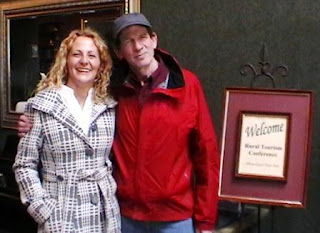


This week was an historic one for rural BC and for the role of tourism in its diversification. The first BC rural conference was held at the South Thompson Inn just outside of Kamloops as part of the REDTREE project by Thompson Rivers University. I have been to many conferences over the years and am joining others in saying that this is one of the best ever held in BC. Why was it so great?
The opportunities for learning were unlike any program I have seen assembled around tourism in BC - there were sessions on everything from sustainability, mountain bike trails, signage, product development and capacity building to Web tools, amenity migration and geocaching.
The delivery was innovative - there were lots of workshops, activities, plenaries and plenty of time for networking.
The venue was spectacular - the South Thompson Inn setting provided an intimate gathering spot and everyone remained on site to create space for networking and developing ideas. The staff was great and the food was fantastic (and local).
The delegate list was diverse - the session had lots of rural operators, council members, aboriginal leaders, policy makers from federal and provincial agencies, field agents, academics, consultants, students and marketing associations. This provided a rich set of players to share ideas, realities and voices to the complex array of stakeholders involved in tourism development. And, no one audience was privileged in their links to tourism in the province. They came from all corners of BC and from outside the province including Alberta, Quebec, California, Sweden and Brazil!
For me, the event was very special as it marked the realization of a vision that I shared with my colleagues in TRIP since 2006 when we learned that rural operators and leaders wanted a venue to get together to share and learn together. Watching people from all over the province shake hands, sit down together and learn from the wealth of knowledge around the venue was fantastic. I had the opportunity to reconnect with people we met on the road with our students, and I had the chance to meet new people like Anna Pollock and Joanne Steele whose work I have admired.
One of the goals of TRIP was to develop a cluster of expertise and network around rural tourism in BC and it was so evident that we can collectively check that one off our list. Our partners were well represented in the event, and some of my closest colleagues and students who engaged in TRIP extension tours were all around and involved. This showed the follow through and commitment of the partnership to seeing our ideas through and in fact, we are all leaving inspired to do more... (keep posted for new ideas for a TRIP phase 2!).
Congratulations to Rob Hood and his great team at TRU including Sydney Johnsen, Cynthia Schaap and all the great students. The organization was super and kept people engaged throughout. We truly had a great "experience". In particular though, when I talked about doing things using a rural lens, the team did many things to make the conference work for rural BC residents including:
They invited them to the event
They tailored the topics to suit their needs
They created a travel subsidy to make it accessible
They recognized that their time away from the community was valuable and ensured an action packed learning program
They kept it in a rural setting
They benefited a rural operator
They used workshops to allow for engagement and learning
They kept the speakers relevant to rural issues and realities
They focused on the big picture facing rural BC
They made room for socializing amongst delegates by having adventures, socials, bus outings, and plenty of networking time
And probably many more.
We are talking about the logistics for the next gathering and are committed to continue the opportunity. Keep posted, tell your contacts and register early because based on the success of this inaugural event - it will sell out super quick!
PS - the adventure studies program offered a social opportunity on Wednesday night and my team was called the "Roper's" due to Miriam Schilling's abilities with a lariat in one of the activities. Our team photo includes Gavin McLelland (being caught), Miriam Schilling, myself, Victoria Simpson,Kimberly May, and Sara Weaver (Simone Carlysle-Smith was missing for a moment).


Subscribe to:
Posts (Atom)