Redirect

Showing posts with label destination development. Show all posts

Thursday, September 20, 2012

Pondering product development

Yesterday I had the good fortune to spend the day in the room with a collective brain trust of people from BC to ponder tourism product development.  The day was organized by staff of Ministry of Jobs, Tourism and Skills Training (Tourism British Columbia). It was a super opportunity to relay a number of insights that I have gained through fieldwork, research and comparison to other destinations over the years. I know that the perspectives shared by the wisdom in the room will be helpful for BC to continue its pursuit of excellence as a destination.

Many of my previous posts touch on the topic of product development. I find that the topic is often a misunderstood concept among people in tourism.  While product is one of the "p's" in the traditional marketing sense, in tourism, it is often neglected in terms of overall strategy.  At the provincial or national level in many destinations, one can see that the majority of funding and other supports are targeted toward "promotions" as they are assumed to bring the best return on investment.  But, for many rural communities - or destinations that are at early stages of development - the product is not at a state of readiness to be able to provide consistent, high quality experiences (the actual product in tourism). And thus, from an economic development standpoint - these areas are missing out on opportunities to benefit from tourism at the local level and this potential revenue is also lost for the regional/provincial economy.  For these areas, a focus on product is vital to allow them to enter into the market and for the redistribution and circulation of financial benefits within a province.

But, it is not just about rural communities - all innovation processes rely on a commitment to continuous quality improvement. Investing into product is a requirement for all long term success of tourism destinations. Tourism experiences are dynamic and must remain responsive to social trends.  What is popular today is not guaranteed to be popular tomorrow and as such, reflection on what experiences are offered, where and for who is critical for destinations. The business world does this take up at the local and firm level, but there is a role for regions and provinces to reflect on this as well and to provide appropriate supports to enable the market to function in a way that visitors can connect to emerging products.

I am always on the watch for innovative product development supports around the world - and this is an opportunity to share a few that are worth looking at. For those that want to know more (or share others with me)- take a peek at these...

Hawaii Tourism Authority - Product Enrichment program. The HTA's Product Enrichment Program funds a number of programs supporting efforts to ensure a quality tourism product and unique experiences. Included are the County Product Enrichment Program, Community-Based Natural Resources Program, and Kukulu Ola: Living Hawaiian Culture Program.


Canadian Badlands Corporation - Canadian Badlands Ltd. (CBL) is a not-for-profit Alberta Corporation providing a new and innovative approach to creating an integrated, destination-based tourism industry in South-Eastern Alberta. CBL is the largest co-operative regional partnership of municipal governments in Alberta. The shareholders are 62 municipal governments recognizing the power of co-operative efforts to develop and implement a strategic regional tourism development plan. Check out their array of product development supports!


The US Extension System - the Public University system in the US has an extension system to provide supports for communities and regions within the University territories. I have benefited tremendously from working through Michigan State years ago, and my favourite conferences remain to be the National Extension Tourism Conferences where all of the folks who do on the ground work in product development gather every couple of years.  The range of innovative supports provided through these Universities is a great asset for all levels of government to take note of. Take note of Texas, Minnesota, and Wisconsin.

Market readiness programs - Helping operators go from good to great and keeping the idea of innovation alive is at the heart of market readiness programs which are popular in Eastern Canada. Check out Newfoundland , and NF Labrador.

Mentorship programs - to allow businesses to learn from who they really want to learn from - successful entrepreneurs!  Check out Nova Scotia's program

Share other ideas - what do you need, what do destinations need or what do you know about that really works?


Sunday, August 26, 2012

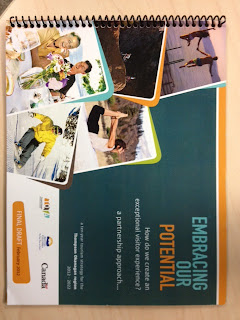
Thompson Okanagan Tourism Association Regional Strategy


I have long wondered why our planning processes around tourism are often so short sited and so promotion focused when tourism is a powerful change agent that takes years to develop and requires the efforts of so many different stakeholders. Complexity is hard to deal with I guess...
But I have some hope going forward! While in Osoyoos this summer, I had the good fortune to hear about the 10 year regional strategy being put forward but the Thompson Okanagan Tourism Association (TOTA).  I was so impressed, I told Glenn that I would make sure to write down my observations so that other destinations might be able to learn from their good work.

My graduate work focused on tourism planning, and from what I recall in terms of best practices - TOTA's efforts check off a lot of boxes... including:

  1. It is research based.  The plan is based on consultations, surveys, data on consumers travel behavior and regional assets.
  2. It is visitor centric. The research used profiles what consumers do and want vs. what those in the destination assume about visitors. It makes a conscious choice about which visitor markets best fit the types of experiences that are offered in the region.
  3. It recognizes complexity within the regions sub regions. Larger communities and rural areas and the unique nature of their products are incorporated AND there are obvious themes that connect the story and experience together for visitors.
  4. It emphasizes collaboration. This is not a TOTA plan, it is a regional destination development plan that recognizes the range of actors that are required to make it come alive.
  5. It is story based.  Instead of promoting distinct sectors within tourism, it recognizes that visitors have multiple interests in multiple communities and it connects the regions sense of place through stories.
  6. It is non sectoral and shows cross sectoral connections.  Agriculture, wineries, ranching are all connected to tourism through the product offerings which will strengthen the recognition of tourism as an economic and social agent.
  7. It focuses as much on developing and enhancing products as it does on promotion and marketing.
  8. It recognizes the power of tourism and its role in sustainability.
  9. It is forward thinking and long term.
  10. It is creative and it is innovative...
I commend those at TOTA for designing such an innovative process. Innovation is not an easy task - risk takers are likely to encounter resistance and nay sayers - but in my opinion, you are weaving together the threads of a very strong tapestry - a plan that, if people can commit to and monitor - should make the region an icon for BC for years to come.


Friday, May 18, 2012

Maximizing Collective Returns from Tourism

On Wednesday night, I was asked to do a keynote at the Parksville and Qualicum Beach Chambers of Commerce meeting in Qualicum Beach. The two chambers have been getting their members together for seven years now and this gathering had about 170 people in attendance.  I mentioned to them that it was not common for me to see two communities at the business level, come together in this way. This emphasis on collaboration within a somewhat unique region of Vancouver Island is commendable.

I decided to focus my talk on the nature of the visitor experience vs. destination development. While I often like to focus on supply side orientations, I have noted that many stakeholders involved in "product development" often do not understand that the product that is sold in tourism is a visitor experience. So, with that, I described, using others research - what the visitor experience is really all about.  I then used this to segue and deliver the message that many destinations should stop thinking about destination development and they should focus on visitor experience development. This is a growing trend in other countries - Australia links are in the presentation) and somewhat in Canada (Traveler types EQ) and more locally, the BC Tourism Strategy is now focusing on the five stages of visitor experience.

The group was great - they had lots of tough questions for me - but overall, I think the key ideas came across. Thanks Geoff for the invite and Peter for coordinating the event. Well done and continued success.

If you are interested in the presentation - you can find it HERE.
And, I made the news - here is a good summary of my quotes.