Showing posts with label Masters in Sustainable Leisure Management. Show all posts
Wednesday, September 12, 2012
Tourism, arts, culture and economic development at Global Mural Conference
I had the good fortune this week to attend a great conference on arts, culture, economic development and tourism right in my own backyard. The Global Mural Conference was held in Chemainus, BC and the organizers assembled a great combination of speakers for the gathering. The day kicked off with a great video on Chemainus and its evolution. Narrated by Karl Schutz, the video tells a story of vision, leadership, community spirit and success. I was happy to be sharing the room with so many great people, including about 9 of our graduate students from the Masters in Sustainable Leisure Management here at VIU. Their program emphasizes what it takes to create positive collective change, so to witness a local case study where all the components come together was great.
They also had the great fortune to hear from one of the most respected voices in community change - Bill Baker. We heard Bill speak twice during the day - once on secrets of successful destinations and again later on branding. I know many communities have benefited from Bill's work and have witnessed the influence he has had while out on my fieldwork. The day closed with an interesting roundtable session with the Mayors of Qualicum Beach (Teunis Westbroek), Parksville (Chris Burger), Ladysmith (Rob Hutchins) and North Cowichan ( Jon Lefebure). Together, they profiled what their communities have been doing to enhance quality of life and to use tourism, arts and culture as a core economic development strategy. I found their addresses playfully competitive but at the same time, you could tell that there was a respect for one another which is the prerequisite to regional collaboration.
The intimate nature of the conference was great - it allowed people to speak to one another, walk along the streets and hear from different perspectives. The conference had a wide range of delegates from all corners of the globe.
Pulling off these sorts of gatherings is no small feat - and I want to acknowledge the effort of everyone in Chemainus that pulled this together and of the efforts of the speakers to come and share their knowledge and innovation with others. It is the best way to learn - thank you.
Photos - the MA gang with community visionary Karl Schutz and the program of the conference showing sponsors.
Tuesday, September 27, 2011
Dr. Tobias Luthe - first visiting scholar speaks on sustainable consumption in the Swiss Alps
The new Masters in Sustainable Leisure Management at VIU is done in partnership with the World Leisure Organization. As such, we are trying our best to internationalize the content that the students are exposed to. One of the ways we are doing this is to bring in "visiting scholars" or experts in sustainability and innovation. Our first visiting scholar is Dr. Tobias Luthe, Senior Researcher at the Transdisciplinary Sustainability Studies - University of Applied Sciences Institute for Tourism and Leisure Research in Chur, Switzerland.
The Graduate students have been learning from Dr. Luthe in their first course on Paradigms and Principles in Sustainability. Tonight, Tobias will share some perspectives with the public when he gives a lecture on : Sustainable Consumption - innovating products and behavior: the case of tourism in the European Alps. Sept 27, 7 - 9 pm at the Nanaimo Campus of Vancouver Island University in Building 355-203. Join us!
"Todays’ challenges of designing and managing a complex world require innovations in how economies and markets function. Global environmental change further increases the pressure on societal transitions to design resilient and more sustainable economies.
As one example, tourism in the European Alps is of highest regional economic importance while being a saturated industry suffering from climate change and socio-economic developments. Current efforts to increase adaptive capacity focus on maintaining a status quo – clearly lacking innovation and pioneering developments. The Alps have a history though of pioneering success in tourism, such as the train up to the Eiger or the gondola to the Klein Matterhorn. Fresh ideas are needed now to develop an industry that is resilient to change, and that understands change as an opportunity to innovate in both products and services. Such a step requires behavioral changes from all stakeholders, on the production and the consumption side. Sustainable consumption is a paradigm of growing importance that allows to fuel necessary market innovations that can drive Alpine tourism to become more sustainable. This presentation discusses examples of new products and market developments in the tourism industry of the Alps both from a qualitative and a quantitative angle.
Friday, September 23, 2011
Graduate students debate public investment in tourism
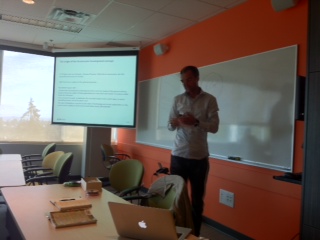
This week, our new Graduate students in the Masters in Sustainable Leisure Management met to debate to what extent public investment should be made into tourism in the Vancouver Island Region. It was held at the Annual Tourism Vancouver Island Conference in Nanaimo from Sept 20-22.
The pro side, led by speaker Laurel Sliskovic, argued that investment into tourism is actually reinvestment into an industry that generates significant revenue for local and provincial governments. The pro team also argued that consistent investment is needed in a number of areas, including into the systems that are required for tourism such as BC Parks.
The con side, led by Marc Sorrie, argued that investments in tourism should come from the private, not the public sector. His team also suggested that there are numerous other competing priorities for the limited public dollars that exist, and tourism takes a back seat to things like health and education. He also suggested that until First Nations agreements are made, public investment would be inequitable and we would not reap the full benefit of the potential that will be present when Aboriginal communities can more fully participate in the industry.
Both teams did a great job of presenting to a packed room full of operators, Mayors, marketing organizations, and a variety of other delegates. I am sure their ideas sparked off conversation for the conference as well. While a show of hands indicated that the pro side won, it was obviously, a biased audience in the room!
I was reminded in organizing this debate at how effective they are in bringing about both sides of issues. We all too often hear what we want to hear, that which validates our own thinking on topics. In a democratic society, where complex issues are all around us - we can learn from these students perhaps, to think about the opposing sides and ideas to try and find common ground to move forward.
Subscribe to:
Posts (Atom)